One of the first performances recorded in the history of the New World was of limbo, the “slave ship dance.” Slave ship logs as early as 1664 document this dance in the experience of enslaved Africans who traveled across the Middle Passage. Known for its effectiveness as a “ritual of rebirth” based on the healthy exercise received from the dance, limbo forms part of the entertainment repertoire in the contemporary tourism industry, and in 1993 to 1994, and 2007 it was a popular dance in dancehall, along with the tatti, the world dance and the erkle. The use of these dances in this way highlights the attempt to locate the history of dancehall in the ancient practice of free Africans and, later, the enslaved peoples… The dance, which involves the body moving under a stick, is thought to have emerged out of the lack of space available on the slave ships, necessitating the slaves bending themselves like spiders. The dance reflects this in the constant lowering of the stick, ostensibly until it touches the ground, and clearing the stick with a lowered back and bent knees presents an ordeal increasing proportionately with the lowering of the stick. This ordeal produces triumph for the dancer who can endure to survive the challenge. The African home and life lost are represented by the bending ordeal, and the promised land to be reached by the triumph of clearing the lowered stick. – “Dancehall: From Slave Ship to Ghetto”

Sonjah Stanley Niaah’s book “Dancehall” is an essential purchase for anyone who cares about music and/or popular culture and REQUIRED reading for anyone invested in contemporary Jamaican music. “Dancehall” is an academic text but Stanely Niaah’s passionate demands for a spiritual and spatial reading of popular culture transcend common misconceptions about the limitations of ivory word-smithing. When she lets her personal motivation and desire take purchase in her subjects Stanley Niaah’s writing takes on the intense urgency of Michael Taussig. I was lucky enough to spend some time with her in Kingston and through our conversations it was clear that this book is merely the vanguard for a larger project of re-inscribing the spiritual into academic understandings of popular culture and urban spatial practices. Her future projects include mapping performance and spiritual geographies and creating a global think tank to theorize best practices for documenting the ephemeral and often hidden worlds of life magic. Life magic being those practices which allow joy and love to manifest in the most marginalized and harshest conditions. SURVIVAL… IN STYLE.

2 Hour 2 Min radio rip exploring the spectral geography of Kingston, Jamaica 192kbps

[audio: http://nyc.duttyartz.com/mp3s/KINGSTONRADIORIP_DUTTYARTZ.mp3]

“Dancehall” takes its historical narrative arc from the spatial developments and growth of dancehall media-ecologies – from the dance yards of slavery days to Japanese sound Mighty Crown touring Jamaica. It would be easy to skim her work and find only this obsession with the constantly inventive and mutating space of (the) dancehall. Dancers bodies, audio recordings, brand Jamaica, and inventive but codified performance all circulate along routes previously uncharted. I am certain, however that Stanley Niaah is extricating a much more powerful and arcane set of practices. Her primary project isn’t about dancehall itself, but merely finds dancehall as the deeply coded and armored viral carrier of African spiritual forces that had to be sublimated under slavery.  If Obeah remains as the truly hidden (and illegal) raw manifestation of communication through consensus reality into deep time and space- dancehall is part of spiritual livitys emergent face, constantly mutating and moving seamlessly through commercial culture to recreate itself. If all of this is a little heavy- and it is, of course, “Dancehall” can also easily be read simply as a powerful addition to our understanding of contemporary media practices and the spatial and cultural ingenuity forced by limited resources. Stanley Niaah mimics this double masking in her own work, creating a text that, like dancehall will spread easily through global academic and research channels without necessarily revealing its true depth. For the initiate “Dancehall” is a powerful introduction to spiritual memetics in mass culture. Living To Perform. Performing to Live.

Cop at Amazon

We’ve slowly been dropping jems out the miraculous mind of Adam Partridge AKA Atropolis AKA the dopest NYC producer you’ve never heard of. His Cumba Mela project has been running for years, burning venues  across the city. It shouldn’t have been a surprise when his debut  album came to us fully formed. Most producers might throw out a slew of remixs or singles  while refining their sound – but the Atropolis sound doesn’t need to gestate 0ne bit.

Atropolis is Lush and humid with a digital veneer that leaves dancefloors dripping. Guest vocalists Anbuley and Noelia Fernandez push instrumentals that could easily  stand alone into synesthesic territory. Future Latin rhythms you’ll play from front to back without having to touch your preferred control surface. Soundtrack to a  sunrise ride home through Queens when you’re not ready for the party to end? We got you. In the North, Atropolis will run all summer. If your just getting into winter, it’s the electric blanket you need in your life. CD and Digital.

If you missed them circulating grab Atropolis’ truly mind melting Rita Indiana remix and original Asi Asi Asi below.

Rita Indiana – Los Poderes (Atropolis Remix)

[audio: http://downloads.pitchforkmedia.com/Rita%20Indiana%20-%20Los%20Poderes%20(Atropolis%20Remix).mp3]

Atropolis – Asi Asi Asi Feat. Noelia Fernandez

[audio: http://nyc.duttyartz.com/mp3s/Atropolis_Asi_Asi_Asi.mp3]

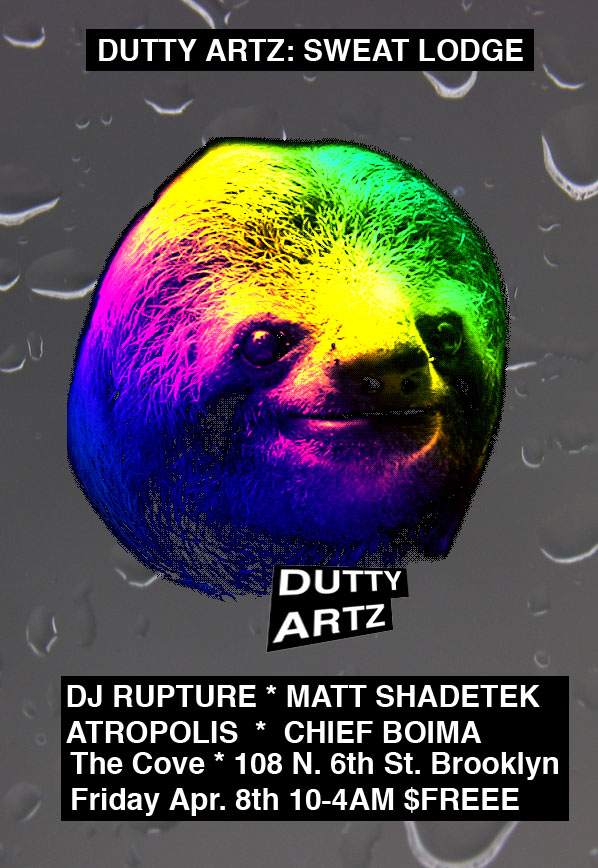
Expect a new mix and few more bits to find their way onto your DL folder before the month ends. His live debut will be at our May 12 Sweat Lodge….

Chimu Pots Representing Decapitated Heads (Museo del Larco, Cusco)


“They’re widows,” the woman standing behind the till explained. I had spotted the two viudas, Rosita and Ricardina, dancing slowly to the huaynos playing on the speakers. This was one of those tiny stores that seem to sell everything.  On this Saturday, I stopped in to ask the way to the one discoteca in Ollantaytambo—one of longest continuously occupied settlements in Peru. The town lies on the banks of thw Orubamba River, which runs through the Sacred Valley. Agricultural terraces (“andenes”)—from the age of the Incas—slice through the steep sides of the Andes. Inca stone houses, temples, and look out posts dot the mountainsides. An hour-long train ride would bring you to Macchu Pichu.

Rosita swayed with her liter bottle of Pilsen beer; Ricardina grabbed my hands in her rough hands, teaching me how to step and slowly spin around to this popular folk music. A shrill voice sang of how dead mothers, traitorous lovers to saccharine cascades of the harp.

“Somos campesinas,” the women repeated. “We’re peasants.” Ricardina told me she was 30 and had three children, and that Rosita was 35 and had five children. They each looked at least ten years older than they said. Rosita handed me their glass and poured me a cup of their beer.

Before leaving, I asked the shop owner if she sold huayno CDs. She began leafing through a stack of her own burned CD-Rs. “Here, this is another copy of who we’re listening to.” She handed over a CD marker-scrawled “Alicia Delgado” to me. I asked her the cost. “Whatever you feel like,” she answered. I handed her two sol coins.

A couple days later on a drive between Cusco and Pisaq, our taxi driver was playing huayno from a USB stick connected to his car stereo. The USB stick dangled where a rosary or pine-tree-shaped air freshener might hang. I told him that I had bought an MP3-CD of Alicia Delgado. “She dead now,” he intoned, “She was murdered in her home. Someone tortured her first.” He said this was never solved, but guessed it probably had to do with money since she was rich.

In Lima, a few days later, after stopping in at the used LP market, Galeria Quilca, I mentioned Alicia to another taxi driver, a friend of a friend. “Yeah, she was murdered by her girlfriend,” he said in California-accented English. “Abencia Meza also sings folkloric music. She was a better singer and made Alicia famous too, but then Alicia cheated on her with her harpist.”

“Abencia is out of jail now and has a new girlfriend. In Lima, you know, you can get someone to kill for you. There are places, neighborhoods to go to. You can get someone to kill for $50,” my driver told me. “That’s why I’m friends with everyone,” he smiled. “It’s much better that way.”

Alicia Delgado-Regresa Madre

[audio:http://nyc.duttyartz.com/mp3s/066%20regresa%20madre.mp3]

Alicia Delgado-En Una Noche de Luna

[audio:http://nyc.duttyartz.com/mp3s/alicia%20delgado-%20en%20una%20noche%20de%20luna.mp3]

In just a few hours, today’s radio show with special guest Daniel Hernandez! Mudd Up Mondays 7pm-8pm EST wfmu.org 91.1 FM NYC.

Image

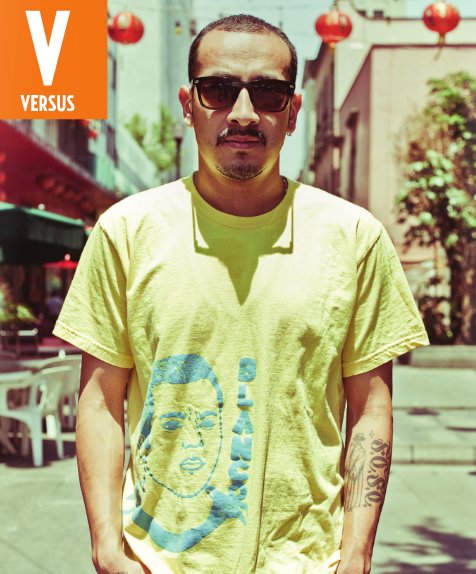
[Daniel Hernandez, photo by Hector ‘Chucho’ Jimenez for http://frente.com.mx/]

I previewed tonight’s show here. The above portrait comes from a recent Spanish-language interview in Frente (warning: it’s one of those horrible flash-based sites whose ‘digital layouts’ ensure that none of the content can ever be linked to). Clearly, Daniel brought the heat to our city today. The radio show kicks off his NYC stint, keep an eye out for the Thursday book party + Columbia U. talk

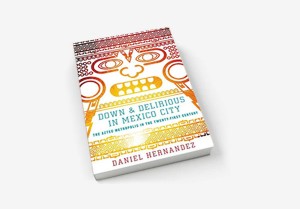
Right now I’d like to excerpt two sections from his new book, Down and Delirious in Mexico City. Together they hint at its narrative arc as Daniel moves from “a sort of native foreigner” to a sharp-eyed chilango whose self has been rewritten by the city he writes of — from ex-punks tending their aging legacies to the birth of fashion blogging to neo-indigenista sweat lodges– with such lyricism and insight.

from Chapter 2: Points of Arrival

“And this is the house where La Malinche lived,” Victor says, pointing to a plain colonial structure on Calle República de Cuba, in the Centro. The building doesn’t seem like much: pink walls, brown wooden doors that appear indifferent to their age, shuttered windows. On a wall high above the sidewalk, a tile marker with blue cursive script indicates that “according to the tradition” the house once belonged to a woman named Doña Marina. Also known by her Indian name Malinalli Tenepal, Marina served infamously as Hernán Cortés’s translator and mistress during his conquest of the Aztec empire.

Uff,” I respond, and frown. Among some Mexicans in the United States, La Malinche is reviled as a traitor, the Judas Iscariot of the New World. By grunting I think I am doing my duty.

But Victor, an artist with whom I have struck a fast friendship, recoils. “You Chicanos need to get over the conquista,” he says. “La Malinche was amazing. She was incredibly smart and beautiful and knew many languages. She is one of the only women historical figures we have from the period.”

I am strolling with Victor after lunch. It is a warm and drizzly day, mid-July 2002, just a few weeks into my first visit to Mexico City. From the moment I land, nearly every human interaction and every street corner turned offers an eye-widening lession. The onslaught of information and sensations leaves me fatigued. Almost anything I say is analyzed, mocked, or critiqued in relation to my being a sort of native foreigner — a Mexican born in the United States, Mexican but not quite. Victor’s reproach shocks my brain. . .

And then, crescendoing with feverish visions after several years spent in D.F., we get to this section of chapter 15: The Seven Muses of Mexico City:

Everything is thrilling in Mexico City because everything is out of whack. There is a sense of delirious rupture, everywhere. The Cathedral, built over a dead Aztec temple, is sinking. The video game arcades are packed. I’m looking at male stripper clubs for women in Iztapalapa, extremely open public displays of affection on the metro, between men and women, children, and men and men, at political propaganda calling for the death penalty for kidnappers. A man without legs is begging on the sidewalks, just a human stump riding a skateboard. A little indigenous girl is stricken with panic, screaming in an indigenous language, as she gets off a metro car before her mother can reach the closing doors. On the platforms, the blind are walking with blind. Chaos and mutation on every corner. How, I wonder, can we mediate the doom?

We are not asking it enough. We are watching out for ourselves, like true urban rats, wondering, What is it that I want? I fall into the same mind-frame, thinking lecherously, I want it all. I want clothes. I want the Hustle. I’m a Mexico City mutant eating sidewalk hamburgers for dinner under a pounding brown rain. I want cactus juice to flow through my veins. I want to dance upon the pyramids. I want to sweat droplets of jade. I want acid.

+ + +

Bogota’s Frente Cumbiero has a year-old mixtape of originals and edits, which makes for a fine soundtrack to our displaced Mexico City memories on this warm Nueva Jork / Puebla York / Neza York day:

– ROMPETRINCHE – MIXTAPE by FRENTECUMBIERO

domusmixtapelive

This week is Design Week/International Furniture Fair in Milan, and I’ll be eating delicious #food then giving a special performance as part of Domus magazine’s week-long event series Urban Futures.

On Wednesday April, 13th, starting at 9pm, you can catch musician Giuseppe Ielasi (whose work may be familiar to listeners of my radio show), followed by DJ N-Ron and myself, bringing the party with video-projection accompaniment across a 28-meter long wall courtesy of dotdotdot‘s ‘architectural video mapping’. At the Salone 2011 (Opificio 31, Via Tortona 31).

big 336470 3776 dett2 LOW[dotdotdot’s rendering of their wild video wall]

Domus’s week of events looks fascinating. Includes talks on the Post-Oil City and The Open-Source City, bringing in heavyweights from OMA, MoMA, Fritz Haeg, and more. For the Twitter-view: @DomusWeb.

The Harlem Is Nowhere mix that I did with Sharifa Rhodes-Pitts early this year is part of Domus’s City Mixtape series. After Milan I return to Casablanca, where we’ll base the Beyond Digital project (instead of Marrakesh) this summer.

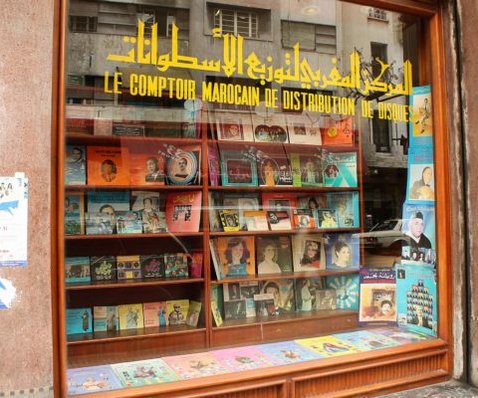
Casablanca is north Africa’s largest city. It’s big and gritty, center to Morocco’s music industry and art scenes… As well as an incredible vinyl spot, Le Comptoir Marocain de Distribution de Disques (26 ave. Lalla Yacout). Here’s a nice writeup on CMDD: pt 1|pt2 and some photos. One of the world’s great record shops!

cmdd1

[Le Comptoir Marocain de Distribution de Disques, photo from Tales from Bradistan blog]

[Guillaume de Machaut depicted in 14th ct. French miniature]

You can stream last night’s radio show for deep, consistently fascinating discussion from Liturgy! Topics include: tremelo strumming, 19th ct. Romanticism, encore vs apocalypse, the value of effort, and my esoteric theories regarding Hunter Hunt-Hendrix’s esoteric theories. Liturgy’s musical selection began with 14th ct Frenchman Guillaume de Machaut and ended with Nusrat Fateh Ali Khan. In between you’ll hear weighty black metal, including previews from their upcoming album on Thrill Jockey.

How to follow up such a rich show? With another equally rich show.

Next Monday, April 11th, I’ll be joined by Daniel Hernandez, author of new book Down and Delirious in Mexico City: The Aztec Metropolis in the Twenty-First Century. I read an advance copy late last year, it floored me. SO GOOD. Honest, searching, implicated. Lovely to experience Daniel in longform (he’s a great blogger, too). Most alive non-fiction I’ve read in ages, and the prose communicates D.F.s insane energy, which is major. For the past two years I’ve been devouring all I can about Mexico City, from Spanish-language contemporary noir novels to John Ross’s epic history El Monstruo, and Daniel’s work shines out – can’t wait to take the conversation to the airwaves.

when does a battle mix become a ceasefire mix? avant-garde was originally a military term – the foremost guard in the army advancing into conflict. battle mix. myself and jon hanuman. the peace was brokered by the abstractor blog (based in Caracas/Barcelona/Elsewhere) and is therefore bilingüe.

it’s available with tracklist and even interview here.

here’s a couple of my selections in full. happy to spread the love/weaponry further. requests down below…

first, an old UK Garage cut from 99. future garage is a simultaneously occurring future which is also happening in the past…

m dubs feat lady saw – bump n grind (original mix feat secret agent)

[audio:http://www.wordthecat.com/images/m_dubs_feat_lady_saw-bump_n_grind_(orig_mix_feat_secret_agent).mp3]

second: adesh samroo is from trinidad. he makes chutney soca (that’s soca made by trinidad and guyana’s large populations of south asian – imperial – extraction). This tune is from his ‘thanks to all’ album. It makes a good case as to why cat meat is better than dog meat.

adesh samaroo – D’ dog bone

[audio:http://www.wordthecat.com/images/adesh_samaroo-d_dog_bone.mp3]

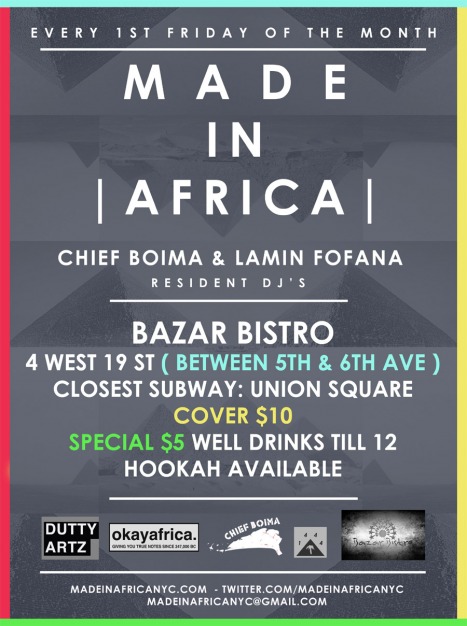
We’ve moved location and day

Now Made in Africa is every 1st Friday of the month at Bazaar Bistro North African Restaurant in the Union Square area.

And we’re every first FRIDAY Night of the month! So if you couldn’t make it before because it was on a weekday, now’s your chance.

$5 Well Drinks until midnight

Again Birthday Celebrations, contact us for special deals details!…

$10 Cover

And Hookah/Sheesha available

Facebook event page here.

& here’s a video for all the gyals + man dem who like to see man wine! dance competition in cote d’ivoire –

[youtube width=”525″ height=”393″]http://www.youtube.com/watch?v=rFfSZCLSK3k[/youtube]

Last night’s radio show had a nice line pulling through it. Began with some powerful Marrakchi sounds and lifted into the ether from there. As the comments grew increasingly surreal.

Mon. 3/28/11 7:25pm max: hey rupture I was curious as to your thoughts on odd future

Mon. 3/28/11 7:27pm /r: I’D LIKE TO SEE AN “ODD” FUTURE IN WHICH A GROUP OF YOUNG BLACK WOMEN MADE SOME CRAZY ART AND RECEIVED A FRACTION OF THE ATTENTION HEAPED ON ODD FUTURE. #GENDER
. . .
Mon. 3/28/11 8:02pm k:/: will definitely be returning to this show, louder than i can play it in my office. wow. my mind is official blown. thanks much.

Mon. 3/28/11 8:03pm max: No you didn’t misunderstand, get the Audiobook version of Pale Blue Dot if you want Sagan reading Sagan. He doesn’t read the whole thing but theres a solid couple hours of Sagan reading Sagan, it’s pretty awesome even if the info is out of date

Mon. 3/28/11 8:03pm CARL SAGAN?!: Somewhere out there, /r, in the multiverse, that book is waiting for me to find a wormhole so that I can get to it and read it.
. . .
Mon. 3/28/11 8:05pm streets ahead: last night, a cosmologist saved my life

TRACKLIST: (more…)

Radio tonight! Tunes from Morocco plus fresh sounds from Matthewdavid, Egyptrixx, Blawan, Laurel Halo, Lamin Fofana, and more… 7-8pm EST. wfmu.org. 91.1fm NYC.

Then next week, it’s LITURGY! I last saw Liturgy’s founding member Hunter Hunt-Hendrix in Amsterdam. He was reading the new Deleuze Guattari biography and telling me about a gringo who moved to Mexico City to make impossible music for player pianos. Time before that was in Tennessee. Hunter was holding a manifesto he’d written on transcendental black metal, the importance of ‘rupture’, and ‘the blast beat’. Clearly, there’s a lot going on.

HHH2-400x600

[Hunter Hunt-Hendrix]

The 4-piece are perhaps NYC’s heaviest and most hypnotic live band, it’s a textural, choral, intense experience that ends up feeling like floating. They’ll join me to talk about American transcendentalism, guitar bodies, ritual space, infinite limbs, and more. I honestly don’t know what negro black metal is, but maybe we’ll discuss that, too. Plus they’re bringing in a deep selection of music to share.

Dre Skull is label boss, ill producer,and  dope DJ. His Club Infinity Parties with Kingdom are legendary. His label Mixpak has been dropping pure fire since jump. On a lot of levels he’s pushing a similar sound to what we rate at DA- but he’s also been doing some leftfied releases putting his stamp on Japanese punk, Sissy Bounce  and some of contemporary dance halls most distinctive voices.  I linked with him in early March  on his last visit to Kingston to finish sessions with Vybz Kartel on their collabo full length. The trip started slow for Dre. Apparently even if Kartel says your his favorite producer, he doesn’t always pick up the phone or keep meetings. After last minute Caribbean flights for engineers and Dre lengthening his stay- everything got wrapped. Between sessions with Tifa and waiting on Kartel, Dre previewed the album for me- mostly unmixed, with a couple of tracks needing some revamping- IT SOUNDED FIRE. West Coast G-Funk Dancehall like “My Crew” are going to BURN radio, club and freeway play- but Dre and Kartel also finished minor-chord livity anthems like “Ghetto Youth”, “Real Bad Gyal” an ode to women to run dem own tings,  and gyalist anthems for days like the infectious “Half On A Baby.” Looking at sales of dancehall full-lengths, it’s hard to known, from a financial standpoint, why Dre’s putting his time and cash behind the project. But if music is actually about content, then I truly hope this one pays off.  I hit him with some questions about how he sets his things, and what we have to expect from him and Mixpak in the future.

Youtubery= I asked him to pull a couple older K/Cartel tracks for us since everyone said Dre has him sounding hungry like when he first came out.

[youtube]http://www.youtube.com/watch?v=NtUNtvkoUC0[/youtube]

T: What/how has the logistical process been working with Jamaican artists?

D: The process has varied from project to project.  The first few projects were all done over the internet, starting when I reached out to work with Sizzla and then Vybz Kartel.  Once Kartel’s ‘Yuh Love’ hit, I started getting Jamaican artists reaching out to work with me.  That’s how the Ms. Thing and Psycho Tanbad track came about, her manager hit me up and requested the riddim and then they went ahead and shot the video on their own.  More recently, I’ve been going to Kingston to work with artists directly, so everything on this upcoming Vybz Kartel album has been recorded with Kartel and I in the studio together.  Logistically, I always bring the riddims pretty well built (with chorus melodies and fully structured arrangements) and then I take the vocals back to Brooklyn and rework the riddim around the vocal as needed.

T: What can you tell me about releasing Hard Nips- a japanese all girl punk outfit in Bk- up until that release the Mixpak sound seemed to be all about international forward thinking bass music- how do they fit in with the vision you have for Mixpak?

D: To me Mixpak is much broader than any one type of music, though I realize that being a relatively young label certain appearances can take shape, but I hope that over time a broader picture emerges.  I’d like to grow Mixpak to be an XL sort of label focusing on full lengths and I’m choosing that as a reference, not because I’m overly familiar with what they’re putting out, but because my brand impression is that, as a label, they just want to put out the “best” of new music (as opposed to many labels that aspire to release the “best” of a certain genre or sub-genre).  That idea of “best of new music” is what I picture for Mixpak, though as a producer I have my own areas of interest and that will probably always shape the label’s output.

T: Besides yourself, who does the Mixpak team consist of?

D: For day to day label operations, Mixpak has mostly been my project.  For better or worse, I code the website, make the phone calls, handle merchandise, deal with distributors, etc.  For the Mixpak blog, I’ve had a great team of writers and contributors from around the world, we’ve got people from the US, Canada, The Netherlands, United Kingdom and then there’s a Japanese team who translates every blog post and interview into Japanese.  I’ve recently brought onboard a London-based woman, Susannah, who functions as the editor of the blog and I’ve been working to get her more directly involved with running some other aspects of the label.  I’ve reached the point where I’m definitely a bottleneck and that can hold up getting projects done on time, so I’ve been working to build a system that won’t need my involvement quite so much.  I’m hoping that will free me up to work on more of my own projects and will help the label continue to grow.

T: Beyond the full length with Addi, what else are y’all going to bring out into the world this year?

D: We have a whole lot of stuff in the pipeline.  We have an all analogue EP from Parisian synth wizard Koyote, a debut EP a ridiculously prolific teen computer music prodigy Andy Petr, a Lil Scrappy remix EP with Dam-Funk and Justin Martin remixes, a Dre Skull & Oliver Twizt single, a Schlachthofbronx soca EP, a single from Stamma Ramma, a follow up Melé EP and more.  I’m also getting other voicings in Kingston and beyond, so I’m expecting some more Dre Skull projects at some point this year.

[youtube]http://www.youtube.com/watch?v=tnvFCQJMaVE[/youtube]

T: Do you feel like the controversy over Kartel’s bleaching should have any bearing on his musical output or career?

D: I don’t feel like I’m the most qualified to speak to that, but I’ll just say that being in Kingston for the last week it seems like the two most prevalent views among people are either that “he’s denigrating his heritage” aka he’s reacting to shame about the color of his skin in a shameful way or that “he’s a man exercising his right to self express through body modification” aka he doesn’t give a damn about anyone else’s social norms.  People who hold the first view are definitely concerned, but people seeing this from the second perspective see him as something like a rebel and they respect it from that angle.  I suppose whether this should or will have any bearing on his musical output or career will be up to the fans, but from the looks of things in Kingston, he doesn’t appear to be having any trouble.  As far I can tell, he seems to be more popular than ever.

T: Can you tell me a bit about your life as a producer- I first heard the Juiceboxxx projects that you did a long while ago and kind of locked you into that vibe- but the last few years its become obvious that your comfortable moving between genres…. how do you see your own production work in relation to UK developments in bass music vs American strains of powerfully local music genres – which youve dipped into with Lil Scarppy, and Sissy Nobby.  What are your dream projects/collabos?

D: The biggest piece about my life as a producer I could share is that the vast majority of music I have produced has never been released.  I probably have over a thousand unreleased tracks at different stages of completion and that music spans a very wide range of sounds and genres.  For a long time, I’ve considered a lot of my time in the studio as an exploration and I say that, mostly, because I didn’t even really conceive of releasing it for a long time.  Currently, I’m in a different phase in my life as a producer, so I do think about releasing tracks these days, but retrospectively I see all that production work over the years as having been a process of building a palette that I can now reach for on any given day in the studio.  I still have the project files associated with all those tracks, so I can pull a melody or a drum pattern or anything from any old track.  On the Kartel album for example, the song that is likely to be the first single consists of a bassline and melody that were written on a laptop in the back of the band Lightning Bolt’s van in 2002 or 2003 during a 45 day cross-country tour.  So in making the track for Kartel, I pulled up those components from all those years ago and built a new track with new drums and sounds, but it’s musically the same chords and notes. There’s another track on the album that I produced in 2005 which was always a dancehall riddim and I just brought the track to Kartel as I first wrote it.  Back then, I really didn’t know how to get a track to someone like Kartel, so I made the track as an exercise, but I always liked it, so I held it waiting for a day when maybe I would be in a position to use it.  So in a lot of ways my life as a producer is only starting to publicly take shape, but I’ve been a studio head for years.

Jumping back to Juiceboxxx, our project was a very intentional exploration of a certain set of influences that we shared, starting with hip house, so we approached it from a pretty conceptual place.  It’s cool, we’ve both come a ways since then in terms of our careers – he recently toured opening for Public Enemy and I’ve been working with Kartel, Lil Scrappy and a number of other people – but the truth is, I don’t think either of us has changed it up too much, it’s just a question of things taking there due time to unfold.

In terms of dream projects and collaborations, this Kartel project feels like I’m living the dream and like the culmination of a lot of what I’ve been working towards. Another thing I’d like to do is produce a rap album with me doing the full production on the album and really trying to shape something from start to finish.  I don’t have a particular rapper in mind, but I’d love to play a small part in bringing single producer rap albums back.

/Interview

If you want more in depth info on Dre and his work in JA- check his amazing interview with Erin

I’ve been into Kalup Linzy’s work for awhile now — you can still listen to a RealAudio stream of his November 2007 appearance on my WFMU radio show, or grab our collaborative song, which we performed at PS 1’s Warm Up this past July (remember summer? I CAN’T. THIS NEW YORK WINTER IS ENDLESS).

james franco kalup linzy

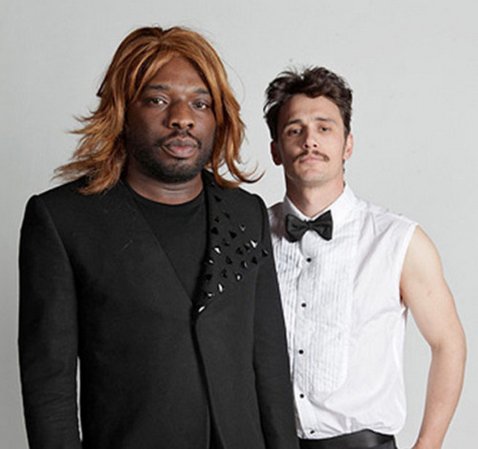
[Kalup (Linzy) and (James) Franco]

Kalup started working on music with James Franco last year, and they just gifted out a sweet spacious preview track, fresh off the laptop. I’ve heard some of Kalup’s work-in-progress, and this new jam is one of my faves. James Franco’s interpretation of Joni Mitchell’s “Both Sides, Now” with additional music and lyrics by Kalup Linzy:

NEXT THURSDAY MARCH 31ST

Que Bajo?! returns to NYC after touring Miami, Medellin, Barranquilla, Bogota, Cali, and SXSW… come hear exclusive new remixes from myself, Uproot Andy, DJ Orion, Toy Selectah, Isa GT and more and check out our guest DJ’s Venus X of the Ghe20 Gothik Party who just rocked the shit out of the fader fort at SXSW and Panchitron from the Peligrosa All Stars crew down in Texas. Pancho’s mixtape stayed in heavy rotation last month for Que Bajo?! fans
Thursday March 31
Le Poisson Rouge
158 Bleeker St
11pm -$10

[youtube]http://www.youtube.com/watch?v=6FDG_Xm39mY[/youtube]